What Is a “Titan Swap” on a Nissan Truck?
A Titan swap is a popular suspension modification for Nissan’s mid-size 4×4 trucks and SUVs – notably the 2nd Gen Frontier (2005–2019 D40), 2.5 & 3rd Gen Frontier (2020-2021 & 2022+ D41), 2nd Gen Xterra (2005–2015), and R51 Pathfinder (2005–2012). Despite the name, it doesn’t involve swapping an engine or entire chassis. Instead, a Titan swap normally means installing front suspension components from the full-size Nissan Titan onto these smaller trucks. The Frontier/Xterra/Pathfinder share key front-end dimensions with the Titan, allowing its beefier control arms to bolt up with minimal hassle. The result is a dramatically wider front track (~3 inches wider per side) and about 3–4 inches of lift gained from the suspension alone. Most importantly, a Titan swap provides longer suspension travel – often 9-10 inches of front wheel travel (versus ~6 inches stock). In practical terms, this upgrade gives you the ground clearance, articulation, and ride quality akin to an expensive long-travel off-road race kit, but using mostly factory Nissan parts at a fraction of the cost.
In simple terms, a Titan swap is the ultimate front suspension upgrade for these Nissan 4x4s. By widening the stance and using Titan’s longer control arms, you unlock far more upward and downward wheel movement. This makes the vehicle much more capable off-road – soaking up bumps and keeping tires on the ground over rough terrain. It also provides a notably smoother ride on-road, especially for trucks lifted over 2 inches, because the suspension isn’t straining at its limits. The wider stance improves stability in corners and off-camber situations (though the tires will stick out farther). Many enthusiasts describe the Titan-swapped Frontier or Xterra as “a full-size truck hiding in a mid-size body” – you get big-truck suspension performance without the bulk.
Importantly, “Titan swap” generally refers only to the front suspension. The rear suspension on these Nissans is usually addressed separately (with lift shackles, add-a-leaf springs, extended shocks, etc., which are readily available). Swapping Titan components onto the rear axle isn’t required – often just leveling the rear to match the front lift is enough. So when we discuss Titan swaps, we’re focusing on the front-end transformation. Now, let’s dive into exactly what parts are needed and why this upgrade is superior to a standard lift kit.
Parts Needed for a Titan Swap Front Suspension
One reason the Titan swap is so popular is that it can be accomplished with a collection of mostly bolt-on parts from Nissan’s parts bin. To successfully Titan swap the front of a Frontier, Xterra, or Pathfinder, you will need the following components:
-
Titan Lower Control Arms (LCA): These form the foundation of the swap. The Titan’s lower A-arms are considerably longer than the Frontier/Xterra stock arms, pushing the wheels out ~3 inches on each side. OEM Titan LCAs (from a 2004–2015 Titan or Armada) will bolt up to the mid-size truck’s frame because the mounting points are the same. Some DIYers source used Titan arms from salvage yards (we will never sell or install used parts), but you can also buy new aftermarket replacements.
-
Titan-Width Upper Control Arms (UCA): The upper arms must also be extended (Titan length) to match the wider track. Aftermarket UCAs are strongly recommended for proper alignment and maximum travel. Companies like SPC, Dirt King, and Z1 Off-Road offer Titan-swap-specific UCAs that bolt into the Frontier/Xterra shock tower but have the length and angle for the Titan width. They make alignment easier and provide a high-clearance arch to avoid contact with the coil bucket. (We’ll discuss coil bucket contact more later.) High-quality UCAs also use heavy-duty or greaseable ball joints that can handle the increased travel range.
-
Extended-Length CV Axles: If your truck is 4WD, you need longer front axles to span the increased distance between the front differential and the wheel hubs. There are a couple of approaches here:
-
If retaining the stock front differential (R180): Use Infiniti QX80 (or late Nissan Armada) front CV axles, which happen to have the correct extended length for a Titan-swapped Frontier. The QX80 axles mate up to the Frontier’s diff splines and the Titan-width wheel hub. For 2005–2019 models (27-spline diff output), a common choice is TrakMotive part # NI8433 (QX56/QX80 axle). For 2020+ Frontier (D41), Nissan changed the front diff’s spline count from 27 to 30 splines, so the older QX80 axles won’t fit. Instead, you can use TrakMotive part # NI8574, a 30-spline axle that provides the needed length for 2020–2024 Frontiers. In all cases, you’ll need two axles – one for each side.
-
If upgrading to a Titan front differential: Some swappers choose to install the Titan’s M205 front differential for greater strength (the Titan diff is a beefier unit that bolts into the Frontier/Xterra frame with minor tweaks). If you go that route, you would use Titan 4x4 front CV axles instead. Just be sure to match the gear ratio of your Titan front diff to your rear diff. (For example, many Titan diffs are 3.36 or 3.54 ratio; your rear end may need re-gearing if different.) Note: D40.5 and D41 cannot be regeared as of the time of this article, so a front diff swap isn't possible right now. Hopefully that changes in the future and we can update this!
-
-
Extended Tie Rods or Adaptors: With the wider track width, the steering tie rods must reach further out to connect to the knuckles. There are a few solutions here:
-
On older models (2005–2019), one approach was using Titan inner and outer tie rod ends. The Titan inners thread into the Frontier steering rack and give extra length, and Titan outers fit the Titan knuckle. This is our preferred solution.
-
Another solution is to keep your Frontier/Xterra outer tie rod end and extend the length of the inner tie rod. There are tie rod extension sleeves that thread onto the inner rod and effectively lengthen it, allowing the outer end to reach the wheel. These extensions ensure plenty of thread engagement on both ends, but can be a brittle weak point in the front steering linkage. They also require rechecking for torque regularly.
-
For the 2020+ Frontier (D40.5 & D41), Nissan threw a curveball: the steering rack and outer tie rod threads changed from M16×1.5 to M14×1.5. This means older Titan or Frontier rod ends aren’t compatible. The solution that we use is a one-piece extended inner tie rod designed for Titan swaps on 2022+ Frontiers. We have the correct part numbers for this, but there are also aftermarket options from CJD and others. Regardless of model year, proper-length tie rods are critical to achieve correct alignment after the swap.
-
-
Titan Swap Coilovers (Front Shocks & Springs): Neither the stock Frontier/Xterra nor Titan shock assemblies are long enough for a Titan swap – you’ll need extended-travel front coilover shocks. We strongly recommend Radflo coilovers that are purpose-built for Titan-swapped Nissans. Radflo has been making Titan-swap-specific coilovers for decades, with ideal valving and extended/collapsed lengths to maximize travel and provide the best ride. They offer 2.0″ and 2.5″ diameter coilovers (the 2.5″ versions can even come with remote reservoirs and adjustable damping). These bolt into the factory locations but are longer than stock to accommodate the new arms’ travel range. These will let you achieve around 10″ of wheel travel and a ~4″ lift height while maintaining control.
-
Extended Front Brake Lines: With greater droop travel and a wider stance, the front brake hoses are too short. Extended lines are available and required for any Titan swap.
-
Miscellaneous Hardware: Another item you’ll need are alignment cam bolts (if not already installed). It’s also common to install wheel spacers in the rear after a Titan swap, since the front track width becomes ~6″ wider overall. Spacers ~1.5" to 2″ per side on the rear axle will square up the stance so front and rear track widths match – this is optional, but many do it for aesthetics.
Pro Tip: At SWAT Customs, we can supply complete Titan Swap kits or individual components (like Radflo coilovers, Titan control arms, etc.) and provide expert installation. We’ve performed numerous Titan swaps – including on brand-new 2022+ Frontiers – so we’ve worked out all the needed parts and tricks to get the job done right. If you have a D40.5 or D41 Frontier we have a handy parts kit available here!
Titan Swap vs. a 3″ Lift Kit – Why It’s a Game Changer
You might be wondering: Why go through all this trouble instead of a simple 2–3″ lift kit? In the Nissan 4×4 world, Titan swapping is widely considered the superior approach to lifting and improving your suspension, as it solves many problems that plague the typical lift kits. Here’s how a Titan swap stacks up against standard lift options:
-
Dramatically Increased Wheel Travel: A typical 2–3″ lift on a Frontier/Xterra (using spacers or aftermarket coilovers at stock width) does not add much wheel travel – in fact, many budget lifts simply push the suspension to the top of its limit and reduces overall travel. The Titan swap, by contrast, gives you longer arms and shocks specifically designed for more travel. The average Titan-swapped truck sees 9+ inches of front travel (some builds pushing near 10+″). That’s roughly double the wheel travel of a stock truck (~5.8″). More travel means the suspension can soak up larger bumps and dips without bottoming out or topping out, which improves off-road capability and ride comfort. By comparison, even a high-end stock-length coilover will net you maybe 6–7″ of travel, limited by the short arms and the dreaded coil bucket contact (discussed next).
-
No Coil Bucket Contact (CBC): Coil bucket contact is the bane of many Nissan lift kits. This happens when the upper control arm (UCA) contacts the lip of the coil bucket (the frame’s spring perch) at full droop. Lifting a stock-width suspension changes the UCA angle such that even small bumps can make the arm hit the bucket with a loud “clang.” Spacer lifts are notorious for causing CBC – even a 1/4″ thick spacer (≈1/2″ of lift) can lead to contact if the stock UCA geometry isn’t corrected. This not only sounds awful (metal-on-metal clunk), but can damage your UCA or ball joint over time. Aftermarket UCAs help by providing more clearance, but if you over-lift on stock arms or shocks, CBC is almost guaranteed. Titan swaps eliminate this issue by design. The longer Titan-spec UCAs are shaped to clear the coil bucket at full droop, and the shock length is tuned so that the arm doesn’t hit the bucket before the shock runs out of travel. In other words, a properly set up Titan swap won’t bang the coil bucket – no clunks, no dents in your bucket, and your suspension can use its full travel freely. This is a huge advantage in both off-road performance and on-road refinement.
-
Superior On-Road Comfort and Control: Surprisingly to some, a Titan swap isn’t just for hardcore off-road flex – it greatly improves on-road ride quality too, especially for lifted trucks. Why? With a conventional 3″ lift (say, a spacer on top of stock shocks or even a preloaded coilover), your suspension is almost maxed out at normal ride height. There’s very little downward travel left, so when you hit a dip or speed bump, the suspension “tops out” harshly. In contrast, Titan swap suspension has a much greater range. Even at a 3–4″ lifted height, the wheels still have plenty of droop travel available. The high-quality coilovers (like the Radflos we prefer) are valved to soak up bumps without transferring shock to the frame. Many owners report that after Titan swapping, their truck rides better at 4″ of lift than it did with a 2″ lift kit. Body roll can increase slightly due to the absence of a front sway bar (more on that below), but this can be managed. Premium shocks with adjustable damping allow you to dial in firmer compression/rebound to control body motion. Overall, you’ll experience a more supple ride over potholes, less head toss, and improved high-speed stability because the suspension isn’t binding or hitting bump stops constantly. It’s a night-and-day difference from a typical budget lift.
-
Wider Stance = More Stability: By increasing the track width ~6″ overall, a Titan swap gives your truck a broader footprint. Off-road, this improves stability on uneven ground and reduces the risk of tipping on rough trails. On-road, the wider stance can make the vehicle feel more planted in corners (albeit with a bit more lean if no sway bar). You may need fender flares or mudflaps to cover the wider tires (to "stay legal," check your state's laws), but many see the trade-off as worth it for the gains in handling and the aggressive look of the wider track.
-
Stronger Components: Titan swap not only boosts performance but also durability. The Titan control arms and CVs are beefier, being designed for a heavier truck. The ball joints and tie rods you’ll install are typically heavy-duty aftermarket ones. If you opt for the Titan M205 front diff, you’re gaining a lot more strength over the stock Frontier R180 diff (a common weak point when running big tires off-road). In essence, you’re fortifying the whole front end. As one off-roader put it: “Increase track width for stability? Check. Increase wheel travel? Check. Stronger diff? Check. Just badass overall? Check.
Bottom line: A Titan swap yields capabilities that no off-the-shelf lift can match. You get near-long-travel suspension performance – greater comfort and control over any terrain – whereas a normal lift is mostly just for looks and a slight height boost. In fact, many who try spacer lifts or “leveling kits” on these Nissans end up unhappy with the ride and issues like coil bucket contact. We never recommend those quick-fix lifts. If your goal is a truly functional lift that can handle off-road abuse and daily driving with equal ease, the Titan swap is hands-down the best approach for Nissan Frontiers, Xterras, and Pathfinders.
Suspension Travel: By the Numbers
To put the improvement in perspective, let’s look at some travel numbers for the front suspension:
-
Stock Frontier/Xterra: ~5.8″ of wheel travel (compressed to full droop). In stock form, these trucks actually have less than 6″ of travel, which is why they tend to bottom out or top out easily when driven fast off-road.
-
“Stock-width” 2–3″ Lift: ~6–7″ of travel (estimate). If you add an aftermarket UCA and slightly longer shocks (like Bilstein 5100s or OME coilovers) without changing the control arm length, you might gain a small amount of additional travel – but you’re often limited by CV angles and coil bucket contact. Many report only a marginal improvement. Essentially, you’re still constrained by the same suspension geometry.
-
Titan Swap w/ Quality Coilovers: ~9–10″ of travel (typical). As noted, most Titan swap setups net around 9″ of usable travel. For example, our Titan swap kits with Radflo coilovers regularly measure in that range. This is a massive 50-70% improvement in travel. Some specific setups can reach ~11″ if tuned for max droop (for instance, running limit straps and allowing the shock to droop further), but ~9–10″ is a safe, reliable range without overstressing parts.
-
Full Long-Travel Kits: 12–14″ of travel. Just for comparison, a racing long-travel kit (like Dirt King, Total Chaos, CJD) with custom long arms and axle shafts might get into the 12+ inch range. These kits cost many thousands more than the Titan-Swap parts list and are very involved to install. The Titan swap gets you into the ballpark of their performance for much less money, which is why it’s often called the “factory long-travel” hack.
In real-world use, that extra travel means you can hit bumps and whoops off-road at speed without bottoming out, and you maintain traction over uneven terrain that would leave a stock-suspension tire in the air. Even on-road, more travel equates to a smoother experience over things like railroad crossings or potholes – the suspension can move instead of transferring the jolt to the chassis. Once you’ve driven a Titan-swapped Nissan, a stock one feels stiff and skittish in comparison.
Titan Swap Compatibility and Model Differences (D40 vs D41)
We’ve alluded to differences with newer Frontiers, so let’s clarify how Titan swap applies across the models:
-
2005–2019 Frontier & 2005–2015 Xterra: These D40-generation trucks are the most common Titan swap candidates. The process and parts needed are exactly as described in the sections above. The frame pickup points for control arms are identical to the Titan, making it a bolt-on affair. The stock front differential is an R180 with 27-spline outputs, so the Infiniti QX56/QX80 extended axles (27-spline) are used for 4WD swaps. The steering uses M16 inner/outer rod threads, so Titan inner tie rods work great.
-
2020–2021 Frontier (D40.5): Nissan gave the last couple years of D40 Frontier a new 3.8L engine and 9-speed transmission, but the body and chassis were largely carryover. The Titan swap is still completely doable on these. However, starting in 2020, Nissan quietly updated a couple of front-end components in the Frontier. The front diff stub spline changed to 30-spline (same as the new 2022 Frontier), and the steering rack threads changed to M14 as mentioned. So for a 2020–21 model, you’d use the new spec extended axles (TrakMotive NI8574) and likely need a tie rod extension kit that accommodates the smaller thread. The rest of the swap – Titan arms, coilovers, etc. – remains the same as earlier years. Essentially, treat the 2020–21 as you would a 2022 for parts sourcing. At SWAT Customs, we stay up to date on these changes, so we’ll ensure the correct axles and steering parts for your late-model Frontier build. We have a handy parts kit available here!
-
2022+ Frontier (D41, 3rd Gen): The new-body Frontier is still built on an evolved form of the same chassis (Nissan F-Alpha platform), so guess what – Titan swaps work on these too! We have already Titan-swapped the latest Frontier models and can confirm it transforms the truck’s ride just as it did on the older ones. The differences to note are exactly those described above: the D41 Frontier has the 30-spline front diff (so use the new extended CV shafts), and 14mm tie rod threads (so use appropriate extended inner rods). Aside from that, almost everything remains the same. The Titan arms bolt right in, and the suspension geometry benefits are identical. One thing to mention: the 2022 Frontier PRO-4X comes with new monotube Bilstein shocks, but these are still stock-length – they do not add travel. So, swapping to Titan suspension with proper coilovers is still a huge upgrade on the D41. We’ve also found the new Frontier’s hydraulic steering rack feels great even with the wider stance and larger tires – no major issues there. In summary, Titan swap is alive and well for the 3rd gen Frontier and we expect it to become a common mod for those trucks just like it is for the older models. We have a handy parts kit available here!
-
R51 Pathfinder (2005–2012): The Pathfinder shares its front suspension with the D40 trucks, so you can Titan swap an R51 Pathfinder’s front end just as you would an Xterra or Frontier. In fact, many Pathfinder owners do this to turn their family SUV into a true off-road machine. The Pathfinder has a couple of unique points: If it’s a V8 model (2008–2012 Pathfinder with the 5.6L engine), it may already have the Titan’s M205 front differential from the factory, meaning it’s practically pre-Titan-swapped on the drivetrain side. Also, the Pathfinder’s rear suspension is independent (IRS) with coils, unlike the solid axle leaf spring setup on Frontier/Xterra. So lifting the rear of an R51 to match the Titan front might involve coil spacers or lift springs and subframe spacers (as some builds do). But that’s outside our scope here – the key point is the front can be Titan swapped for the same gains in travel and track width.
No matter the model, the driving experience after a Titan swap is transformative. Your Nissan will feel like a different beast – one that can tackle tough trails with ease yet still be daily-driven (with appropriate considerations for the wider stance).
Coilovers & Shocks: Why We Recommend Radflo for Titan Swaps
As mentioned, the choice of front shocks (coilovers) in a Titan swap is critical. You’re essentially installing a mid-travel/long-travel suspension, and the shocks control how that travel is utilized. At SWAT Customs, our preferred coilover for Titan swaps is the Radflo 2.5” remote-reservoir, and for good reason. Radflo’s Titan swap coilovers have ideal valving and the correct extended and collapsed lengths to get the most travel and the best ride quality. They were among the first to develop a bolt-in coilover specifically for this hybrid suspension, and they’ve really nailed the damping characteristics.
Here are a few reasons we love Radflo for Titan Swaps:
-
Optimized Travel: The Radflo Titan-swap coilovers are built longer than stock to allow that 9–10″ of wheel travel, but not so long that they cause overextension. They’re engineered to prevent the shock from bottoming out or over-drooping into CV bind – essentially “just right” for the Titan arm geometry. This means you’re using every bit of travel safely.
-
Superior Damping & Adjustability: Radflos are true performance shocks. The 2.5″ diameter models with remote reservoirs come with adjustable clickers for compression damping. This lets you fine-tune the ride – softening it up for highway comfort or firming it up to control body motion off-road. With high-quality internal components, they respond well to both slow and high-speed bumps, giving you that smooth, planted feeling even on washboard roads.
-
Correct Spring Rates: We pair Radflos with springs tailored to your vehicle’s weight (accounting for bumpers, winch, etc.). Radflo offers a range of spring rates (550 lb/in, 600 lb/in, 650 lb/in, etc.). We’ll help select the optimal rate so that your truck sits at the desired height and has good ride characteristics. Too soft and you’d bottom out; too stiff and you lose comfort. With the right springs, your Titan swap will feel dialed in.
-
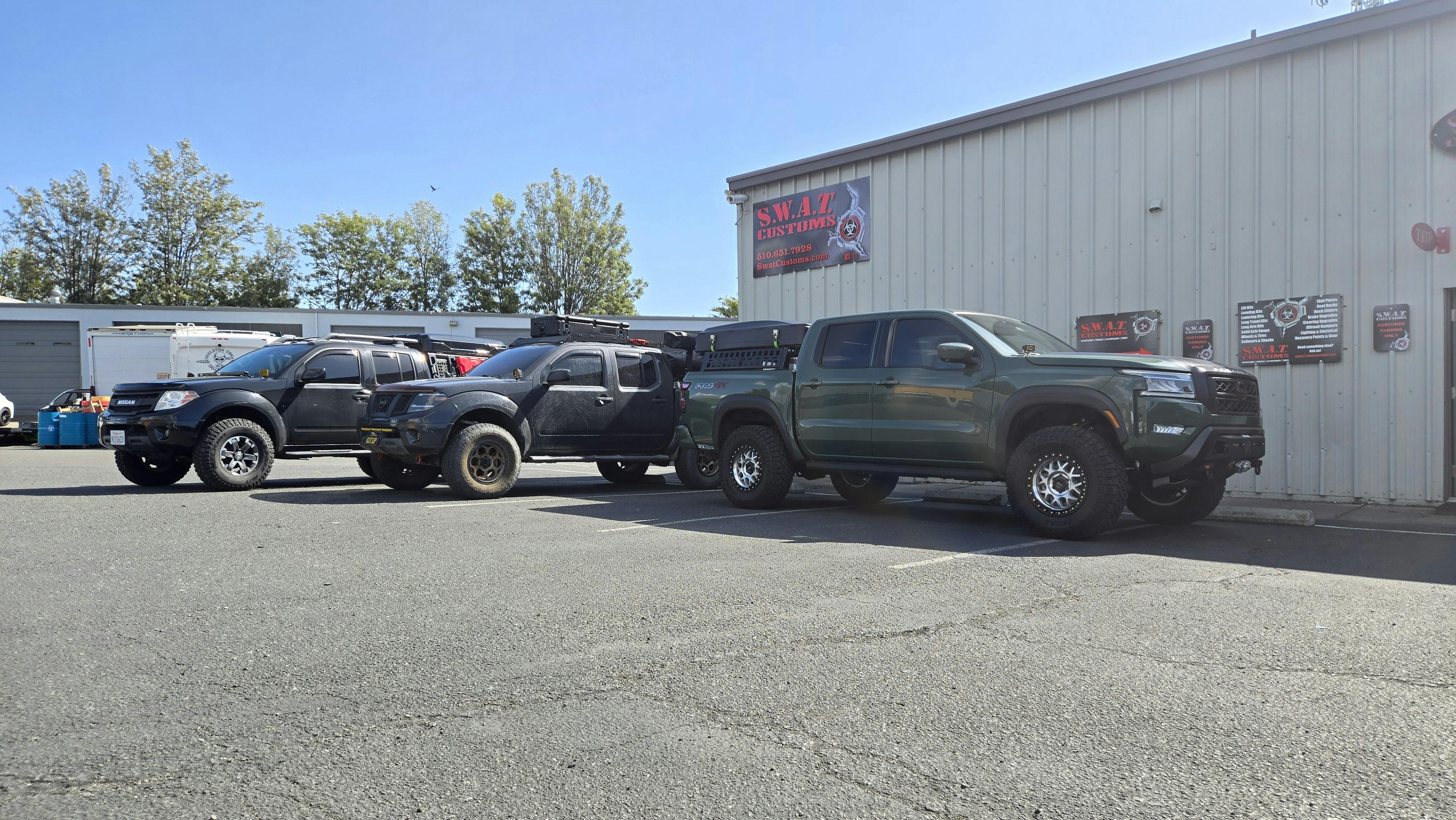
Proven Track Record: Radflo has been the go-to for many Nissan enthusiasts doing Titan swaps for over a decade. We’ve installed numerous sets and found them to be durable and reliable. Rebuilds are possible if you ever wear them out, and parts are readily available. In short, it’s a product we trust on our own vehicles (in fact, our shop’s Frontier Pro-4X runs Radflo 2.5s in its Titan swap).
Of course, other shock options exist. We can install any setup you prefer, but time and again we find the Radflo Titan Swap Specific Coilovers hit the sweet spot for performance vs. cost for most of our Titan swap customers. We’ll make sure your new suspension not only lifts your truck, but truly enhances the way it rides and handles.
Side note: In the rear suspension, if you’re upgrading the front, you’ll want to match it with good rear shocks as well (plus springs or add-a-leafs to get ~3–4″ lift in back). We often use Radflo rear shocks along with either an add-a-leaf + shackle combo or a full replacement leaf pack, depending on budget and desired flex. The result is a balanced suspension that can articulate in the rocks and carry loads for overlanding, etc. But since the focus here is the Titan swap front end, we’ll stick to that topic.
Installation Considerations and Sway Bar Delete
Installing a Titan swap is more involved than a basic lift kit, but it’s still a straightforward job for those experienced with suspension work. Here are a few things to keep in mind:
-
Sway Bar Modifications: In most Titan swap builds, the front sway bar is removed. The stock Frontier/Xterra sway bar cannot connect to the much wider Titan control arms (the end link would need to be far longer and at an awkward angle). Many off-road enthusiasts choose to simply run without a front sway bar. This isn’t as scary as it might sound – the stiffer springs and quality shocks of the Titan swap, along with the wider track, keep the vehicle fairly well-behaved. You will notice some increased body roll in corners, but it’s manageable. For daily drivers who want to retain a sway bar, there are ways to install a sway bar with a Titan swap. One method is using a Titan-spec front sway bar and custom-length end links. However, doing so will limit your suspension travel, because the sway bar will bind up at extremes (exactly what we freed ourselves from by removing it!). It’s a trade-off: you either maximize travel and articulation with no sway bar, or sacrifice some travel for a bit flatter cornering. Many of our customers elect to ditch the sway bar and report that after upgrading to adjustable shocks (and maybe slowing down a bit on sharp highway ramps), they don’t miss it. It’s worth noting the Titan swap was designed to function without the front bar – off-road trucks like this prioritize independent wheel movement over flat cornering. In the rear, the Xterra has a small sway bar that can also be removed for better articulation; Frontiers usually don’t have a rear bar from the factory (PRO-4X didn’t).
-
Wheel Alignment: After the swap, a professional alignment is a must. The aftermarket UCAs make it possible to dial in proper camber and caster even with the 3″-4″ lift. In fact, Titan swaps often align better than some spacer lifts because the components are designed for that ride height. We’ll align your truck in-house and make sure it's perfect.
-
Wheel & Tire Fitment: Titan swapping lets you clear much larger tires, but you’ll need the right wheel offsets to avoid rubbing. Generally, a 33″ tire (285/75R16 or 285/70R17) fits easily with a Titan swap and mild trimming. 35″ tires (315/75R16 or 315/70R17) can be run with more trimming to fenders and maybe a slight body lift or bumpstop tuning. Because the suspension cycles farther, you must ensure tires won’t catch the fenders or body at full stuff – 35s can actually HURT performance due to increased up-travel and hitting the fenders. Also, with the wider stance, a wheel around +18 to +25 offset works well to keep the tires from poking out too far (though some poke is inevitable) and helps tire clearance when turning and at full stuff.
-
Brakes: Some Titan swappers choose to upgrade to Titan front brakes (calipers and rotors) since the Titan knuckles allow it, but if you retain the Frontier knuckles, you’ll keep your stock brakes. That’s usually fine for up to 33″ tires; just use quality pads/rotors. If you want a brake upgrade, we can advise on a path.
Finally, after you’ve got your Titan swap installed and aligned, take it easy for the first test drive. The truck will feel different (in a good way!) – steering a bit quicker due to wider track, suspension much softer over bumps. Do a shakedown off-road run on moderate terrain to cycle the suspension and double-check everything. Then, enjoy the fact that you can hit that gnarly trail or that potholed backroad with confidence that your suspension can handle it.
Ready to Titan Swap? Contact SWAT Customs
By now, it’s clear that a Titan swap is the ultimate way to lift and enhance your Nissan Frontier, Xterra, or Pathfinder. It addresses the limitations of standard lift kits by giving you true suspension travel, improved comfort, and stronger components – essentially transforming your truck into a more off-road capable and trail-ready machine. Whether you’re an avid off-roader, an overlander seeking durability and ride quality, or just someone who wants their lifted truck to drive better, the Titan swap delivers.
At SWAT Customs, we specialize in Titan swaps and Nissan 4×4 upgrades. From sourcing the right parts to the installation, alignment, and any custom touches – we’ve got you covered. Our expert technicians have performed Titan swaps on everything from weekend warrior Xterras to brand-new Frontier PRO-4Xs. We know the ins and outs of ensuring your swap is done safely and performs optimally.
Have questions or ready to get started? Contact us through our online form and we’ll be happy to discuss your build. We can provide a parts list or quote, and schedule a consultation to plan your Titan swap project. Don’t settle for a stiff, limited 3″ lift that might damage your truck – upgrade to a Titan swap and experience the massive difference in both on-road comfort and off-road performance. Your Nissan will thank you with many miles of smooth, controlled travel – and you’ll be driving one of the coolest “Frankenstein” Nissans on (or off) the road!
Unlock your truck’s potential with a Titan swap – contact SWAT Customs today and let’s make it happen.